Kia backflips on Tasman volume goals
Once billed as critical to Kia globally, the Tasman ute is now subject to far more modest expectationsThe News
Mere months after publicly committing to 20,000 annual sales for the Tasman – a number the model “had to get” for global viability – Kia has quietly dropped that target and shifted tone, emphasising realism over ambition.
The Key Details
- Kia has walked back its 20,000/year Tasman volume expectations
- Executives now say that ambition was a goal after slow sales start
- Kia doesn’t want to become a ‘single-model brand’ – a dig at ute-dependent rivals
- Latest VFacts data shows 607 Tasmans were delivered in November, well below its near-1700/month internal benchmark


The Finer Details
When the Tasman launched earlier this year, Kia executives publicly spoke about the global importance of the ute’s success, with internal projections sitting at around 20,000 units annually.
But in a candid update, Australian chief operating officer Dennis Piccoli has now distanced the brand from those goals, saying the early commentary was more about long-term aspiration than short-term expectation.
Piccoli said Kia isn’t chasing the big numbers initially discussed and stressed the brand’s focus was on sustainable growth rather than hitting a headline target.
“We’re not racing towards this 20,000 … we’ve always been about consistency and growing … that is the plan,” he said.


He also acknowledged the pressure of the segment, describing it as “a very, very competitive landscape”.
Despite that, he forecasted a stronger trajectory ahead, with “sales to become, without a shadow of a doubt, much stronger through 2026”.
“We’re working on various corporate and government [fleets] that will complement the existing run rate that we have.”
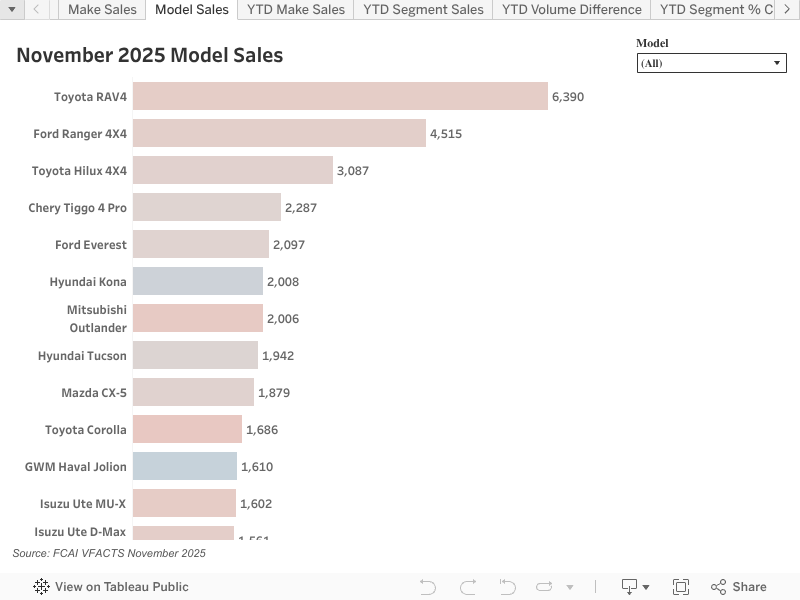
The reality was reflected in the latest round of VFACTS data, which revealed only 556 Tasman 4x4s were sold last month compared to the 4515 Ford Rangers, 3087 Toyota HiLuxs, and 1561 Isuzu D-MAXs – figures that show just how far Tasman needs to climb to reach the upper tier.
Piccoli also cautioned against building the company around a single hero model, taking a subtle swipe at Ford by saying Kia has no interest in becoming a “one-car brand”.
It’s a pointed remark given the Ranger and its SUV twin, the Everest, have made up 88 per cent of Ford’s volume so far this year.
Instead, Kia has insisted the Tasman is designed to complement the broader line-up rather than define it; a position the brand continues to reinforce.
The Road Ahead
Looking toward 2026, Kia says its priority is broadening Tasman’s appeal beyond early adopters and enthusiasts.
A major part of that strategy will be fleet, with the brand expecting a significant portion of future volume to come from government, business and tradie buyers once more variants arrive next year.
The brand believes these new additions – single-cab, 4x2 etc – will give Tasman the flexibility and pricing spread needed to compete more directly with rivals, and build more stable, predictable volume over time.
Rather than chasing a headline sales target, Kia now plans for Tasman to grow gradually as awareness builds and the line-up fills out, and while the ute’s early figures haven’t lived up to its own first-round bravado, the brand remains confident it can carve out a meaningful place in Australia’s second-biggest segment – just not at the pace originally talked up.

Related: VFACTS: Luxury Chinese EV outsells new-gen Korean ute
Related: Kia Tasman S 4x4 2025 Review
Related: Redesigned Kia Tasman breaks cover
Related: No cheaper Kia Tasman grades on the way
Related: Kia Tasman X-Pro 2025 Tow Test
Related: Can the Kia Tasman be a success despite its exterior design?
Related: Kia Tasman SX 2025 Review


Please see our Editorial Guidelines & Code of Ethics (including for more information about sponsored content and paid events). The information published on this website is of a general nature only and doesn’t consider your particular circumstances or needs.


