
Ford looking for a Ranger four-peat in 2026
Revamped line-up and new Super Duty to drive sales reboundThe News
Ford has already placed the Ranger firmly in the fight against Toyota to retain its crown as Australia’s top-selling vehicle for a fourth consecutive year, and despite the NVES and its CO2-snuffing intentions, the Blue Oval will rely on diesel engines to do it.
The Key Details
- Ford Ranger topped Aussie sales for the third consecutive year in 2025
- But sales dropped 9.6 per cent
- Ford says Super Duty and more access to the V6 diesel will reverse that trend
The Finer Details
Despite a 9.6 per cent sales downturn last year, the extensive Ranger ute line-up came out on top of the pile in 2025, resisting the advances of the Toyota RAV4 hybrid SUV and outgoing (replaced in December) Toyota HiLux ute.
The Ranger sold 56,555 examples, the RAV4 51,947 and the HiLux 51,297.
It was the first time since the XE Falcon’s 1982-88 run that Ford has been on top of the leaderboard for so long.
A rebound in Ranger sales will also be vital for the health of the brand.
While it held on to second place overall in 2025 behind dominant Toyota and ahead of close rival Mazda, Ford’s volume declined 5.8 per cent in a static market.
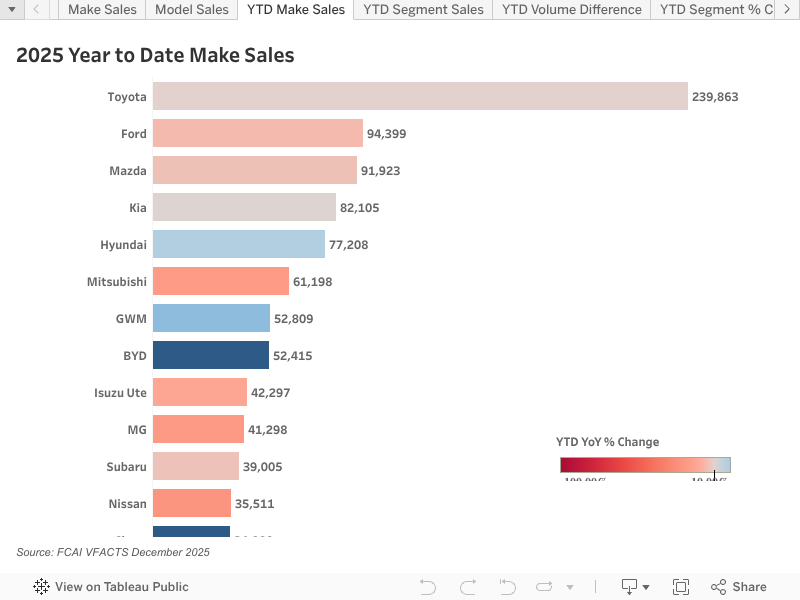
Toyota has already declared its expectation the new RAV4 could become Australia’s top seller as soon as 2026 because ute sales are being shared between too many competitors.
The Ranger and its increasingly important SUV spin-off, the Everest, accounted for 87.6 per cent of Ford Australia’s sales in 2025.
The Blue Oval dominated the niche sports car segment with Mustang and is pushing hard to develop its Transit Custom van volume, but its extensive line-up of T6-based, locally-developed Rangers and Everests are where the action is.
Marketing director Ambrose Henderson has forecast a rebound for Ranger in 2026 as the Super Duty rolls out and the broader range is overhauled with more V6 offerings and the deletion of the ‘wet belt’ four-cylinder bi-turbo-diesel.
“We’re going to continue to see the [Ranger] portfolio expand and therefore sales to follow,” he said.


“As we talked about at the Ranger Super Duty [media] event, that product was all about a business case for incremental sales.
“We expect that to come through in 2026.”
Henderson was also bullish about the recasting of the wider Ranger line-up with more emphasis on the 184kW/600Nm ‘Lion’ 3.0-litre V6.
“Ranger’s success is built on offering customers choice that matches how they work and play, with the MY26.5 Ranger line-up offering the popular 3.0-litre V6 turbo-diesel engine across a wider array of models then previously as a result of direct feedback,” he said.
“This means more customers can now access our most powerful diesel engine in every variant of Ranger.”

But he stressed the continued availability of the single-turbo-diesel, the twin-turbo petrol engine in the Raptor and the PHEV powertrain would also play their part.
“We think we have that covered better than anyone else in the segment and would suggest that the sales results are proving that,” he said.
Henderson cited multiple reasons for the Ranger’s drop-off in 2025, including the ageing of the latest generation toward mid-life (it was launched in 2022) and the flattening of the demand curve in the post-COVID timeframe.
He played down the implications of the general decline in sales of diesel-engined utes, including the Ranger, in 2025.
Essentially, a 0.5 per cent lift in sales year-on-year for the 4x4 ute segment was driven by the petrol-electric BYD Shark 6 plug-in hybrid.
Ford’s own high-priced Ranger PHEV, launched in 2025, failed to make an impact.
“What our customers are looking to do, they’re looking to tow, they’re looking to go around the country, they’re looking at four-wheel driving, all those things which still are best done by a diesel powertrain,” Henderson said.
“And if we look at the sales results for last year, most of the top selling vehicles, again, were diesel powertrains in Australia.
“That being said, we know there’s a transition occurring and we have the Ranger Hybrid, which we’re incredibly proud of.
“But right now we’re led by the customer and what customers are telling us is they need that powertrain to be able to do the work, family and play activities that they do.”


The Road Ahead
Obviously, Ford’s diesel-led product planning is going to fall foul of the NVES CO2 reduction scheme as the decade wears on. It’s already triggered the axing of the Everest 4x2 line-up.
But Ambrose played down the impacts of NVES – at least for now.
“There’s a huge number of factors we have to think about in terms of our business going forward,” he said.
“NVES is one of those factors, but there’s a range of other considerations as well; competitors, exchange rates and material costs, etcetera.”
And while bullish for 2026, he wasn’t prepared to say just how much of a sales increase all these Ranger actions would result in.
“We don’t give future sales forecasts for many reasons, one being I’m sure the other competitors love to know what we’re thinking.”

Related: VFACTS 2025: Toyota tops record year for Aussie car sales, Ford Ranger reigns on
Related: 2026 Ford Ranger Super Duty pick-up and XLT pricing revealed
Related: V6-heavy 2026 Ford Ranger and Everest revealed
Related: Ford is going after Toyota’s top-selling van HiAce
Related: Ford defends Ranger PHEV sales
Join the conversation at our Facebook page
Or email us at editor@carsales.com.au
Or email us at editor@carsales.com.au
Tags


Please see our Editorial Guidelines & Code of Ethics (including for more information about sponsored content and paid events). The information published on this website is of a general nature only and doesn’t consider your particular circumstances or needs.


