
VFACTS: Can Mitsubishi bounce back?
Japanese brand facing falling sales and a limited lineup, but there is light on the horizonThe News
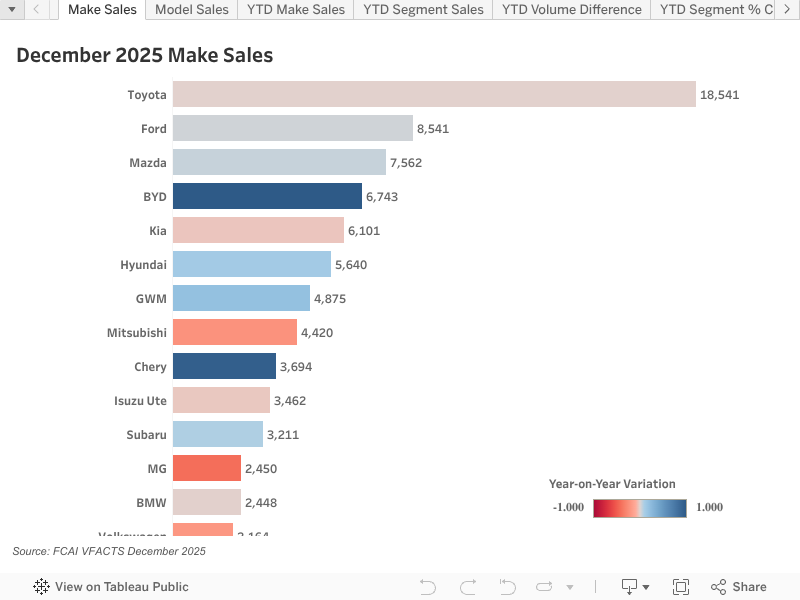
The 2025 sales results didn’t make pleasant reading for Mitsubishi; its 17.9 per cent drop compared to 2024 was the biggest of the top 10 brands, with several key models ceasing production. However, while it’s undoubtedly feeling the squeeze from increased competition, the Japanese brand says there is reason for optimism going forward.
The Key Details
- Mitsubishi sales fell 17.9 per cent in 2025
- Previous ASX, Eclipse Cross and Pajero Sport production all ceased
- New models arriving in 2026, including its first modern EV
- Range refresh a key part of the Momentum 2030 plan
The Finer Details
Mitsubishi Australia sold 61,198 vehicles in 2025, an impressive result that put it sixth on the leaderboard, but also one that constituted a 17.9 per cent drop from its 2024 result of 74,547 vehicles.
It was the biggest drop of any brand in the top 10 and while it only cost it one spot on the overall sales chart, dropping from fifth in 2024, the likes of GWM (52,809 sales) and BYD (52,415 sales) are now snapping at its heels.
However, there are some extenuating circumstances. That 2024 result was a big improvement over the 63,511 sales of 2023, which in turn was a big drop from the 76,991 sales of 2022, so there’s evidence of a trend, and Mitsubishi has bounced back before.
Several key models also ceased production, including the ancient but popular ASX, Pajero Sport and Eclipse Cross, due to not meeting new autonomous emergency braking (AEB) standards, forcing Mitsubishi to rely on existing stock.
These models thus recorded falls of 24.5, 51.4 per cent and 18.7 per cent respectively.
On the other side of the ledger, Triton 4x4 sales increased by more than 10 per cent and thereby increased its market share.
In a statement to carsales Mitsubishi said “2025 was a year of consolidation and transition” as it prepared “for several exciting new vehicles that will come to market” as part of its “ongoing commitment to the Momentum 2030 plan”.


“We said goodbye to the previous ASX, Eclipse Cross and Pajero Sport ranges while introducing the sophisticated new ASX and significantly updating Outlander in looks, ride and handling, and tech,” the statement read.
“We also introduced the full Triton range over the course of 2025, which has enjoyed an increased market share in the light commercial 4x4 segment despite several quality new entries into that space.
“Overall, we finished the year sixth in the sales charts and continue to provide great customer value.”


The Road Ahead
Significant challenges remain for Mitsubishi in 2026, which will test its new local CEO Shunichi Kihara, who was most recently assistant division general manager of the brand’s North Asia division.
The new-generation ASX has launched, but the Renault-based model is significantly more expensive than the car it replaces and won’t achieve anything like the same volume.
Existing stock of the Pajero Sport and Eclipse Cross will dry up, leaving Mitsubishi showrooms with just the ASX, Outlander and Triton for the short term.
The facelifted plug-in hybrid version of the Outlander will arrive shortly, but demand has fallen since the powertrain’s eradication of the Fringe Benefits Tax (FBT) exemption.


The Triton will also come under further pressure in the dual-cab segment from the closely related new Nissan Navara, new Toyota HiLux, refreshed Ford Ranger and increasingly popular BYD Shark 6.
So where are the positives? Later in 2026 Mitsubishi will reveal its first EV since the diminutive i-MiEV; the result of a new joint venture with electronics giant Foxconn and built by Taiwanese automaker Yulon Motor.
A replacement for the Pajero Sport is also inbound – a Triton-based large SUV that’s expected to revive the Pajero nameplate – though it isn’t expected in Australia until later 2026 or early 2027.
The model was teased for the first time by Mitsubishi’s Ralliart performance arm with the suggestion it will replace the Triton as the company’s cross-country rally weapon of choice.

Momentum 2030, revealed in mid-2024, also promised a “heavy investment in electrified powertrains that will secure MMAL’s position as a volume manufacturer to 2030 and beyond ... with several all-new or significantly updated models to arrive by the end of the decade”.
As part of this reveal Mitsubishi Motors Corporation President and CEO, Takao Kato, said: “Australian is a core market for MMC and it makes an important contribution to our global business.
“We will offer not only battery electric but also plug-in hybrids and hybrids and introduce appropriate products that will meet the New Vehicle Efficiency Standards set by the Australian government.”
A Mitsubishi Australia spokesperson told carsales: “In 2026 we are looking forward to introducing the updated Outlander PHEV, with more EV range and more performance than before, as well as some exciting further additions to the Triton range.
“Later in the year we will introduce our BEV collaboration with Foxtron and from a global perspective we look forward to sharing more on the future large SUV to replace Pajero Sport in 2026.”
Related: 2026 Mitsubishi Pajero officially teased for first time
Related: 2026 Mitsubishi Outlander PHEV detailed
Related: Mitsubishi ASX 2025 Review
Related: 2026 Mitsubishi Pajero Sport replacement imagined
Join the conversation at our Facebook page
Or email us at editor@carsales.com.au
Or email us at editor@carsales.com.au
Tags


Please see our Editorial Guidelines & Code of Ethics (including for more information about sponsored content and paid events). The information published on this website is of a general nature only and doesn’t consider your particular circumstances or needs.


